
Magathium

Article

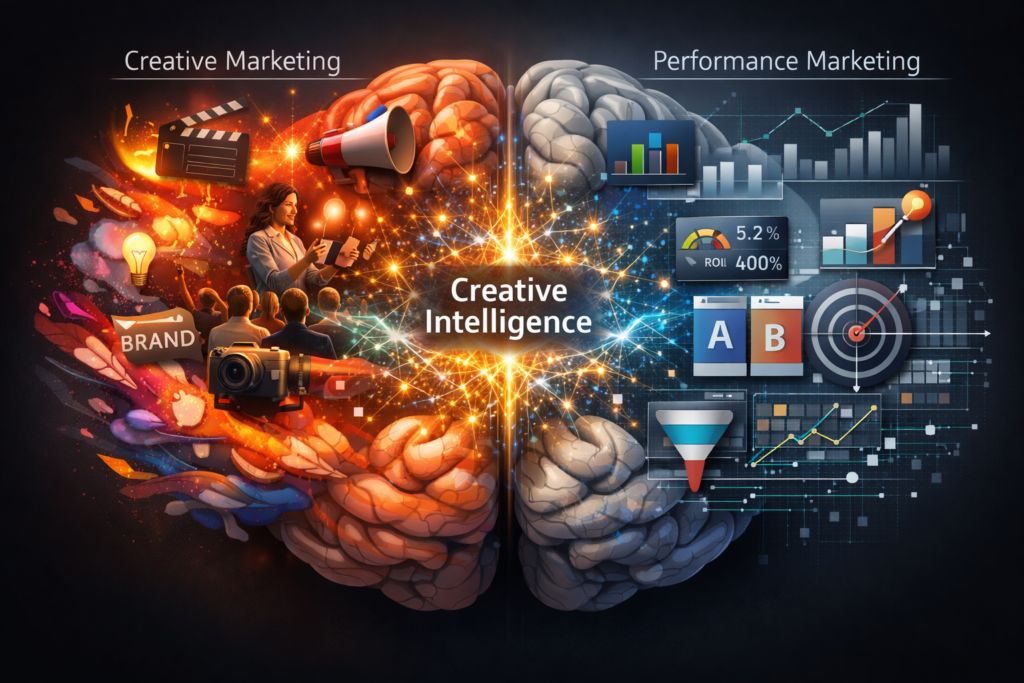
Creative Intelligence: The Bridge Between Creative Marketing and Performance Marketing

Creative Intelligence: The Bridge Between Creative Marketing and Performance Marketing Article | By Rody Zimete Marketing has long been divided into two disciplines that often appear to compete with one another. On one side stands creative marketing, focused on storytelling, brand identity, and emotional connection. On the other stands performance marketing, driven by metrics, conversion rates, and return on investment. Many organizations struggle to balance these forces. When creativity dominates, campaigns may be visually compelling but commercially ineffective. When performance metrics take control, marketing can become transactional and stripped of meaning. The solution is not to choose between the two. It is to integrate them through creative intelligence. Defining Creative Intelligence Creative intelligence is the disciplined ability to connect emotional resonance with measurable results. It ensures that creativity serves strategic objectives and that performance strategies remain rooted in human behavior. At its core, creative intelligence aligns two essential realities. Businesses require growth, revenue, and sustainability. Customers require clarity, relevance, and trust. When marketing addresses both simultaneously, it becomes not only persuasive but durable. The Limitations of Pure Creativity Creative marketing is powerful because it captures attention and builds identity. It shapes perception and differentiates brands in crowded markets. However, creativity without structure or accountability can become expensive decoration. A campaign may generate visibility yet fail to convert interest into revenue. Without performance measurement, creative work lacks direction. It may win admiration but not customers. Why Performance Marketing Alone Is Not Enough Performance marketing offers precision. It tracks engagement, optimizes spending, and identifies which channels produce results. Yet when performance strategies ignore marketing psychology, they risk becoming mechanical. Clicks and conversions are outcomes of human decisions. Those decisions are shaped by emotion, perceived value, and trust. A campaign that pushes aggressively for action without addressing psychological barriers may achieve short-term gains but weaken long-term loyalty. Performance without creativity lacks depth. Creativity without performance lacks discipline. Marketing Psychology as the Foundation Every metric reflects behavior. Every behavior reflects perception. Marketing psychology explains why customers hesitate, why they trust, and why they choose one option over another. It examines cognitive biases, social proof, risk perception, and emotional triggers. Creative intelligence applies these insights to both messaging and measurement. Understanding what people feel is as important as knowing what they click. A Practical Example: Airbnb A clear example of creative intelligence in action can be observed on the platform of Airbnb. When Airbnb emerged, its primary challenge was not simply competing with hotels. It was overcoming distrust. Staying in a stranger’s home introduced psychological uncertainty. Safety, reliability, and credibility were immediate concerns. Airbnb’s brand narrative emphasized belonging and connection. However, the real demonstration of creative intelligence appears in the structure of its platform. Each listing features high-resolution imagery that reduces ambiguity. Host profiles include names and photographs, humanizing the transaction. Guest reviews are prominently displayed, offering social proof. Pricing details, cancellation policies, and ratings are clearly visible, reinforcing transparency. These elements are not aesthetic choices alone. They directly address the customer’s psychological need for reassurance. By reducing perceived risk, the platform increases the likelihood of conversion. Marketing psychology identified the emotional barrier: trust. Creative marketing articulated a sense of belonging. Performance strategy ensured that the experience translated into measurable bookings. The integration is visible and verifiable. Anyone visiting the platform can observe how emotional understanding and business objectives converge. Applying Creative Intelligence in Practice Organizations of any size can apply the same principles. The first step is identifying the customer’s underlying hesitation. Is it fear of making the wrong choice? Concern about price fairness? Doubt about credibility? Once the psychological barrier is defined, creative marketing must address it explicitly. The customer journey, messaging, and visual communication should reduce friction and build confidence. Performance marketing then measures whether those adjustments influence behavior. This is not guesswork. It is alignment. The Strategic Advantage Creative marketing and performance marketing are not opposing philosophies. They are complementary components of a coherent system. Data reveals what happened.Psychology explains why it happened.Creative intelligence determines how to respond. When these disciplines operate together, marketing becomes both human and profitable. It speaks to emotion while delivering measurable impact. It builds trust while driving growth. In an environment defined by noise and competition, creative intelligence is not a luxury. It is a strategic necessity. Work with Magathium Strategy

Creative Intelligence: The Bridge Between Creative Marketing and Performance Marketing Read More »

When Algorithms Learn Psychology: How Meta’s Andromeda Rewards Creative Intelligence

When Algorithms Learn Psychology: How Meta’s Andromeda Rewards Creative Intelligence Article | By Rody Zimete If your Facebook or Instagram ads aren’t performing like they used to, you’re not imagining it. Meta recently introduced Andromeda, a new advertising algorithm that doesn’t just look at clicks and views — it looks at how people feel. In other words, Andromeda learns psychology. And that means the way we approach creativity, strategy, and data in marketing needs to evolve too. What Is Meta’s Andromeda (In Simple Terms)? Andromeda is Meta’s new “brain” behind ad delivery — an upgraded system that studies human behavior and emotion, not just activity. It notices how long people stop to watch, what kind of tone they respond to, what visuals make them curious, and even what type of message feels authentic. Instead of rewarding technical tweaks and targeting tricks, Andromeda rewards ads that connect on a human level. So if your old ads suddenly stopped working, it’s not because Meta wants you to spend more — it’s because the algorithm now speaks the language of emotion. Old Tactics vs. The Andromeda Era Before Andromeda: Success came from clever targeting, fast testing, and audience hacks. You could outsmart the algorithm by adjusting your budget, audience, or ad type. Ads were optimized mainly for clicks or conversions. Under Andromeda: Success comes from creative intelligence. The system rewards ads that make people feel something — that show understanding and authenticity. You can’t outsmart emotion — you have to work with it. In short: “Success under Andromeda isn’t about outsmarting the algorithm. It’s about feeding it creative intelligence.” What Is Creative Intelligence? Creative intelligence is the blend of creativity, psychology, and data. It’s not about making “prettier” ads — it’s about crafting ads that feel right to your audience.That means understanding how they think, what they value, and how they emotionally respond. Example: A cautious customer might respond better to calm, trustworthy visuals. A bold, adventurous audience might prefer energy, color, and movement. When your creative work reflects those inner traits, Andromeda recognizes genuine engagement — and your ads get delivered more efficiently. Why Psychology Is Now the Secret Weapon Knowing your audience beyond age and gender has always mattered — but under Andromeda, it’s everything. The algorithm reads emotional resonance — meaning if your content matches your audience’s psychological patterns, your ads will perform better. Ask yourself: What personality traits define my ideal customers? What emotions drive their choices — security, confidence, belonging, freedom? What kind of story or tone makes them stop scrolling and pay attention? When you start answering those questions, your ads begin to speak the same emotional language that Andromeda listens for. The New Marketing Formula: Psychology + Creativity + Data Winning under Andromeda means combining three forces: Psychology – to understand how your audience feels and thinks. Creativity – to express those insights visually and emotionally. Data – to see what resonates and keep improving. That’s the foundation of a modern creative strategy — one that keeps your marketing human and algorithm-friendly. Andromeda rewards creative intelligence Andromeda doesn’t punish marketers — it rewards those who understand people.It’s not just an update; it’s a shift toward emotional intelligence in advertising. So instead of trying to outsmart Meta’s new system, partner with it by creating ads that think — and feel — like your audience does. Because now, the algorithm isn’t just reading your metrics.It’s reading your message. And when that message connects — Andromeda rewards creative intelligence. Work with Magathium Strategy

When Algorithms Learn Psychology: How Meta’s Andromeda Rewards Creative Intelligence Read More »

Why Some Brands Feel Like Your Best Friend

Why Some Brands Feel Like Your Best Friend Article | By Rody Zimete Ever wonder why some brands feel like they just get you, while others are as forgettable as that lukewarm coffee you had this morning? Spoiler alert: it’s not magic—it’s psychology! Turns out, we humans are hardwired to see patterns and personalities everywhere—yes, even in brands. This quirky tendency, known as anthropomorphism (giving human traits to non-human things), helps us navigate the social world. It’s why we perceive brands as having personalities, just like people. And when brands tap into this, they can create emotional connections that make us feel understood and valued. But how do they do it? That’s where the OCEAN Model (aka the Big Five personality traits) and Brand Archetypes come in. Think of them as the secret sauce for building brand relationships that stick. And here’s the kicker: there’s even a quiz—the MEIA Quiz—that combines these frameworks to help brands figure out how to don their metaphorical superhero cape. Let’s dive into the heart of what makes brands feel human and how they can use psychology to connect with us on a deeper level. Why We See Brands as People (and Why It’s a Game-Changer) When a brand feels like a friend, it’s because we’ve unconsciously assigned it human-like qualities. Maybe it’s the way it speaks to us, the emotions it evokes, or the values it embodies. This isn’t accidental—it’s psychology at work. Take Coca-Cola, for example. Their “Share a Coke” campaign didn’t just sell soda; it sold connection. By swapping out their logo for 150 popular names, Coca-Cola behaved like a human friend who knows us personally. Here’s how they did it: Openness: For people who crave new experiences and creativity, seeing their name (or a friend’s) on a Coke bottle felt personal and exciting. Agreeableness: The campaign encouraged kindness and social bonds, appealing to those who value harmony and relationships. Extraversion: For the social butterflies, sharing a Coke became a public, joyful way to connect with others. Coca-Cola didn’t just sell a product; it created an emotional moment—a shared experience that felt deeply human. Why? Because it tapped into our innate desire for belonging, trust, and self-expression. Dove: The Brand That Cares Like a Friend Then there’s Dove. Their “Real Beauty” campaign wasn’t just about soap; it was about empathy and support. By showcasing real women of all shapes, sizes, and backgrounds, Dove behaved like a trusted friend who sees us for who we truly are. Here’s the psychology behind it: Magician Archetype: Dove transformed how people see themselves, encouraging self-confidence and empowerment. It felt like that friend who helps us see our best selves. Caregiver Archetype: Dove offered warmth, reassurance, and inclusivity. It felt safe, nurturing, and compassionate—like a friend who’s always there for us. Using the OCEAN Model, Dove’s messaging aligned with two key traits: Openness: People who value creativity and challenge societal norms were drawn to Dove’s fresh perspective on beauty. Agreeableness: Those who prioritize kindness and inclusivity felt seen and cared for by Dove’s nurturing tone. But here’s where it gets even more interesting: the OCEAN Model reveals that audiences aren’t just one-dimensional. People are complex, and a carefully analysed, nuanced approach often uncovers multiple personas within the same audience. For Dove, this meant discovering not only their most valuable audience—women seeking self-acceptance—but also different blends of traits, such as those who crave bold societal change or those who value gentle reassurance. This is the power of this approach: it doesn’t just give you a single audience profile; it gives you a rich, multi-layered understanding of the people you’re connecting with. And that’s how you create campaigns that resonate on a truly human level. For many, Dove became more than a brand—it was part of their identity, a source of emotional support, and a reminder that beauty is diverse and personal. The MEIA Quiz: Revealing the Human Connection So, how do you figure out how your brand can connect with customers on a human level? That’s where the MEIA Quiz comes in. This quiz explores the relationship between your brand and your customers by combining two powerful frameworks: the OCEAN Model and Brand Archetypes. Here’s how it works: It asks a series of questions to understand your brand’s personality and how it’s perceived. It connects your brand to its core archetypes (e.g., Magician, Caregiver, etc.). It reveals the customer profile that’s most likely to connect with your brand, based on the psychological traits in the OCEAN Model. For example: A brand with a Magician archetype might appeal to people high in openness, who love creativity and transformation. A brand with a Caregiver archetype might resonate with people high in agreeableness, who value kindness and support. The MEIA Quiz helps brands understand not just who their audience is, but why they connect emotionally—and how to deepen that connection. Why This Matters for Your Brand? Understanding how your brand connects with customers on a human level isn’t just a nice-to-have—it’s a strategic advantage. Here’s why adopting this mindset transforms the way you see your brand, your audience, and even your competition:  Competitive Analysis in a New Light What’s Happening Now: You might think you’re competing with every brand in your industry—but that’s not always the case. For example, Coca-Cola and a luxury sparkling water brand might both be in the beverage industry, but they’re targeting different audiences with different emotional needs. The Shift: When you start seeing your brand through the lens of psychology, you realize competition isn’t just about products—it’s about emotional connections. This mindset helps you identify who your real competitors are: the brands vying for the same emotional space. It’s not about who sells what; it’s about who connects with whom. Unique Positioning Strategy That Stands Out What’s Happening Now: Without understanding your audience’s psychology, you might be positioning your brand in a way that’s too broad or generic. The Shift: When you see your brand’s personality and your audience’s traits through the OCEAN Model and

Why Some Brands Feel Like Your Best Friend Read More »