

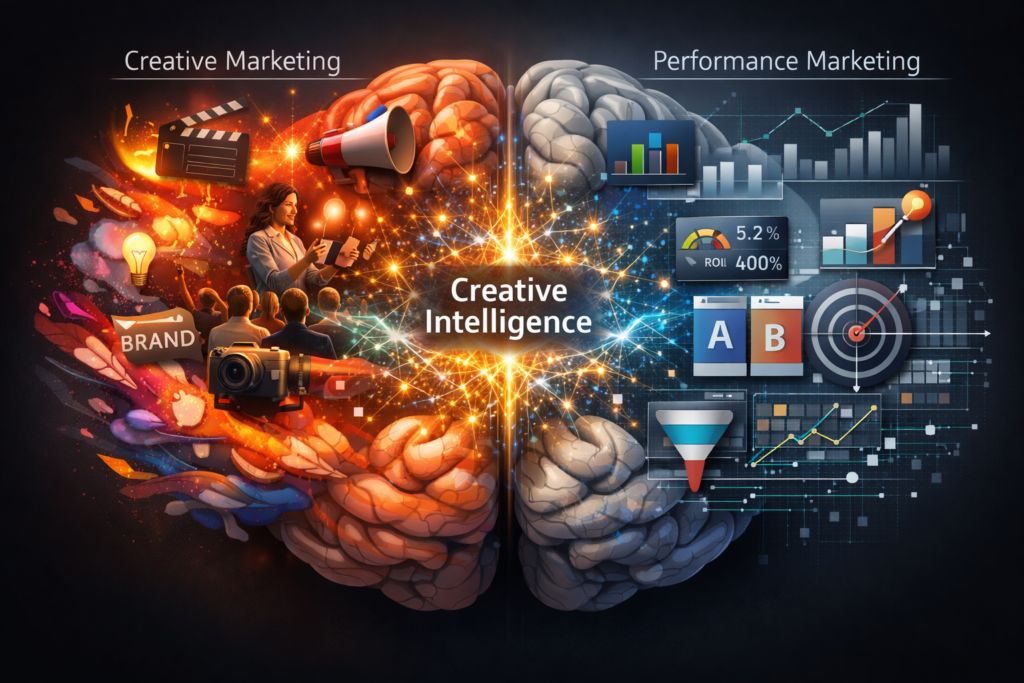
Creative Intelligence: The Bridge Between Creative Marketing and Performance Marketing
Creative Intelligence: The Bridge Between Creative Marketing and Performance Marketing Article | By Rody Zimete Marketing has long been divided into two disciplines that often appear to compete with one another. On one side stands creative marketing, focused on storytelling, brand identity, and emotional connection. On the other stands performance marketing, driven by metrics, conversion rates, and return on investment. Many organizations struggle to balance these forces. When creativity dominates, campaigns may be visually compelling but commercially ineffective. When performance metrics take control, marketing can become transactional and stripped of meaning. The solution is not to choose between the two. It is to integrate them through creative intelligence. Defining Creative Intelligence Creative intelligence is the disciplined ability to connect emotional resonance with measurable results. It ensures that creativity serves strategic objectives and that performance strategies remain rooted in human behavior. At its core, creative intelligence aligns two essential realities. Businesses require growth, revenue, and sustainability. Customers require clarity, relevance, and trust. When marketing addresses both simultaneously, it becomes not only persuasive but durable. The Limitations of Pure Creativity Creative marketing is powerful because it captures attention and builds identity. It shapes perception and differentiates brands in crowded markets. However, creativity without structure or accountability can become expensive decoration. A campaign may generate visibility yet fail to convert interest into revenue. Without performance measurement, creative work lacks direction. It may win admiration but not customers. Why Performance Marketing Alone Is Not Enough Performance marketing offers precision. It tracks engagement, optimizes spending, and identifies which channels produce results. Yet when performance strategies ignore marketing psychology, they risk becoming mechanical. Clicks and conversions are outcomes of human decisions. Those decisions are shaped by emotion, perceived value, and trust. A campaign that pushes aggressively for action without addressing psychological barriers may achieve short-term gains but weaken long-term loyalty. Performance without creativity lacks depth. Creativity without performance lacks discipline. Marketing Psychology as the Foundation Every metric reflects behavior. Every behavior reflects perception. Marketing psychology explains why customers hesitate, why they trust, and why they choose one option over another. It examines cognitive biases, social proof, risk perception, and emotional triggers. Creative intelligence applies these insights to both messaging and measurement. Understanding what people feel is as important as knowing what they click. A Practical Example: Airbnb A clear example of creative intelligence in action can be observed on the platform of Airbnb. When Airbnb emerged, its primary challenge was not simply competing with hotels. It was overcoming distrust. Staying in a stranger’s home introduced psychological uncertainty. Safety, reliability, and credibility were immediate concerns. Airbnb’s brand narrative emphasized belonging and connection. However, the real demonstration of creative intelligence appears in the structure of its platform. Each listing features high-resolution imagery that reduces ambiguity. Host profiles include names and photographs, humanizing the transaction. Guest reviews are prominently displayed, offering social proof. Pricing details, cancellation policies, and ratings are clearly visible, reinforcing transparency. These elements are not aesthetic choices alone. They directly address the customer’s psychological need for reassurance. By reducing perceived risk, the platform increases the likelihood of conversion. Marketing psychology identified the emotional barrier: trust. Creative marketing articulated a sense of belonging. Performance strategy ensured that the experience translated into measurable bookings. The integration is visible and verifiable. Anyone visiting the platform can observe how emotional understanding and business objectives converge. Applying Creative Intelligence in Practice Organizations of any size can apply the same principles. The first step is identifying the customer’s underlying hesitation. Is it fear of making the wrong choice? Concern about price fairness? Doubt about credibility? Once the psychological barrier is defined, creative marketing must address it explicitly. The customer journey, messaging, and visual communication should reduce friction and build confidence. Performance marketing then measures whether those adjustments influence behavior. This is not guesswork. It is alignment. The Strategic Advantage Creative marketing and performance marketing are not opposing philosophies. They are complementary components of a coherent system. Data reveals what happened.Psychology explains why it happened.Creative intelligence determines how to respond. When these disciplines operate together, marketing becomes both human and profitable. It speaks to emotion while delivering measurable impact. It builds trust while driving growth. In an environment defined by noise and competition, creative intelligence is not a luxury. It is a strategic necessity. Work with Magathium Strategy
Creative Intelligence: The Bridge Between Creative Marketing and Performance Marketing Read More »